

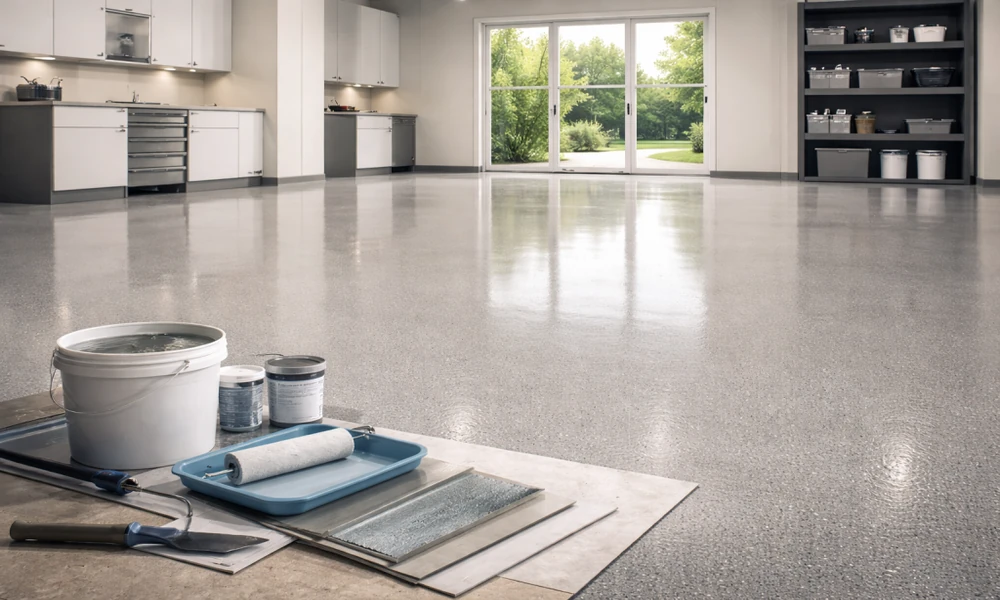
Your warehouse floor just failed a walk-through. A pallet washer leaked near aisle four, and the guy from safety wrote down “slick surface” in three places before lunch. Now you’re pricing repairs while your operations manager wants to know why the floor was ever bare concrete in the first place.
I’ve walked enough industrial spaces on Oahu to know the pattern. Bare concrete gets installed because it’s cheap, then it spends a decade absorbing oil, blush from the humidity, and forklift traffic until somebody notices the damage all at once. A proper coating ends that cycle. For facility managers comparing floor systems, working with an experienced crew that installs commercial concrete coatings in Oahu means you get a surface built for the humidity and salt air that mainland spec sheets quietly ignore.
Here’s what most facility guides get wrong. They treat coating selection as a color and thickness decision. It isn’t. You’re choosing a maintenance schedule, a chemical resistance profile, and a window of downtime you can actually survive. Get those three right and the floor stops being a line item in your quarterly headaches.
Why bare concrete betrays you in a warehouse
Concrete is porous by design. That’s fine under a patio. In a warehouse it’s a sponge for hydraulic fluid, pallet splinters, and whatever drips off the loading dock during a rain squall. Once contaminants get into the pores, no amount of scrubbing pulls them back out.
The slip issue is the one that gets leadership moving. According to the EPA, facility managers carry real obligations around pollution prevention and spill containment, and a sealed floor is part of how you meet them. I’d argue a coated floor should be standard on any Oahu site handling pallet jacks and standing water. The two together are basically a liability generator.
Walk into a warehouse in Mapunapuna on a wet Wednesday and you’ll see it. The moisture doesn’t stay on the dock apron. It travels two aisles in on the tires of every forklift.
A coating system does four jobs at once
When you spec a commercial floor, you’re buying four things in one package:
- Sealing so liquids bead up instead of soaking in
- Texture that keeps footing stable when water shows up anyway
- Chemical resistance against whatever your operation actually spills
- Speed, meaning the hours your crew loses while the product cures
Those four compete with each other. A glass-smooth finish cleans beautifully and turns into a skating rink with one spilled cup of coffee. Grit-heavy texture adds grip and makes the floor harder to sweep. Your job is to decide which tradeoff your operation can live with.
One concrete scenario worth studying. A food processing plant near the airport needs a floor that can survive nightly washdowns with caustic cleaners. A machine shop six blocks away needs a floor that shrugs off cutting oil and dropped tools. Same concrete, wildly different product. If a vendor quotes you the same spec for both, walk away.
How to read a flooring quote without getting played
Here’s the practical part, and it’s where managers get burned. The number on the proposal rarely tells the full story.
- Ask what happens to the existing floor. Demolition or mechanical prep is the hidden line. If it’s not itemized, it’s either missing or padded somewhere else.
- Ask for the cure time in writing. Some systems let you walk on the floor the same day. Others shut your operation for a week. That difference is real money.
- Ask about moisture testing. Concrete slabs on grade here tend to hold moisture, and putting a coating over a wet slab is a guaranteed peel later. Any installer worth hiring tests before they shoot product.
- Ask where the slip rating came from. A tacked-on number without a test standard behind it means nothing. Get the source in the quote.
- Ask what the warranty covers. Peeling and hot tire pickup should be named explicitly. Vague warranties are decoration.
If you only take one item from this list, make it number two. I’d weight cure time heavier than cost every single time, because a shut-down kitchen in Waikiki loses more money in three days than a good floor costs in total.
Restaurant kitchens: the case where downtime decides everything
Restaurant flooring is a different animal from warehouse flooring. You’re not managing forklifts. You’re managing grease, heat, constant mopping, and an owner who’ll notice every minute the kitchen stays dark.
Grout lines are the enemy here. Tile sounds traditional and cleans like a nightmare because grease collects in every seam until it’s a gummed-up mess and the health inspector frowns. A continuous resin surface has no seams to fail. That’s the argument, and it’s a strong one.
The one thing I’d push a restaurateur on is texture choice. Slightly more grip near the dish pit and a smoother finish in the walk-in reads dramatic on the invoice. It’s the right call. You’ll never regret a floor that keeps a dish runner upright during a Friday dinner rush.
Where the coating starts earning money back
Facility budgets like hard numbers. Here’s a frame that’s held up for me: compare the cost of the coating to the cost of the maintenance it replaces over the same period.
| Ongoing cost of bare concrete | What changes after coating |
|---|---|
| Repeated stripping and aggressive cleaning | Routine mopping with mild cleaner |
| Slip incidents and workers comp questions | Documented slip resistance |
| Concrete patching as surface spalls | Sealed surface resists spalling |
| Downtime from unexpected floor failures | Scheduled single installation event |
Run that math over five years with realistic labor rates and the coating almost always wins. The catch is you have to actually budget the coating before the concrete fails, not after. Facility managers who wait for a crisis pay crisis pricing.
Slip resistance is a documented requirement, not a vibe
Safety managers live in walkway documentation, and industrial flooring is no exception. According to the CDC, falls remain a leading cause of workplace injury across industries, and slip-resistant surfaces are part of the standard response. Your coating proposal should name the slip profile clearly enough to defend in a review meeting. If your vendor hands you a brochure and says “it’s grippy,” ask for the test method.
This is also where a local installer beats an out-of-state general contractor. They know how our humidity shifts how these systems cure, and they’ve tested on similar slabs. That local knowledge is worth more than the spec sheet.
Planning at a federal-baseline level
Another sobering fact: even the federal government treats flooring as long-life infrastructure. Per the GSA, flooring in federal facilities is managed as a long-life asset with measured service intervals. That’s a useful benchmark for private managers. Treat your floor like a 10 to 20 year asset rather than a repair line item. The economics look completely different once you frame it that way.
I’d argue that framing is the single biggest lever a facility manager has. A floor you plan for is cheaper than a floor you react to, every time.
Next step
You don’t need a perfect spec to get moving. You need a walk-through, a quote that itemizes prep and cure time, and a slip rating you can defend. Get those three things in hand and the rest of the conversation gets much easier.
Where’s the wet spot currently hiding in your building? Walk the floor this week with a flashlight and a notepad. The answer will tell you almost everything about which system you actually need.
